Billionaire Road
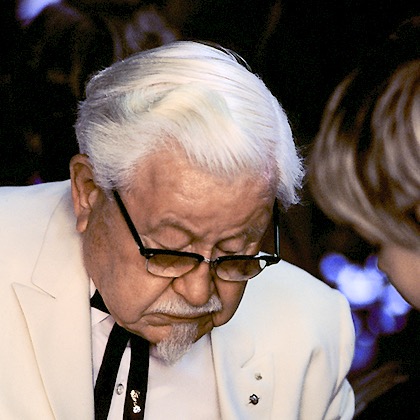
Harland Sanders in his white suit and string tie

Born 1890. Died 1980.

Colonel Harland Sanders

Where the hours went: In the kitchen, then on the road.

At forty he started cooking for travelers at a gas station.
At sixty six he drove his recipe into other men's kitchens.
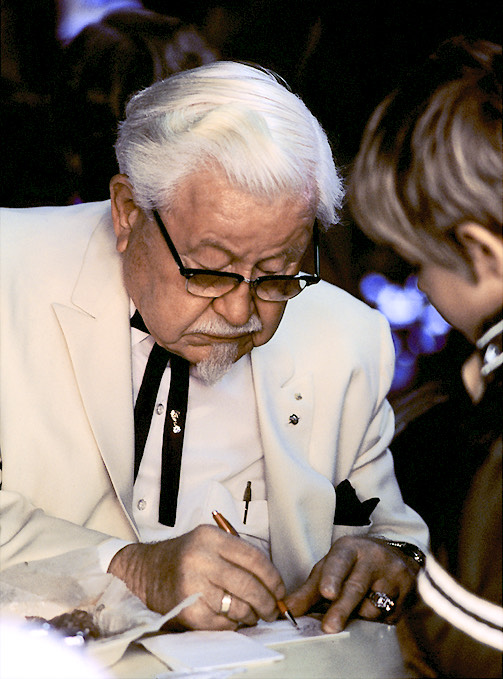
Harland Sanders in his white suit in the 1970s
Dan Lindsay (Edgy01), Colonel Harland Sanders in character, about 1974. Creative Commons Attribution ShareAlike 3.0 (creativecommons.org/licenses/by-sa/3.0), via Wikimedia Commons.

In thirty seconds

His hours

Twenty six years at his own stove, then the road at sixty six.

His rep

Cooking for owner after owner, one kitchen at a time.

It reached

By 1963 more than six hundred places served his chicken.

Most men think the titans got there on talent.
They got there on where the hours went.

01Everything first

At sixteen he lied about his age to join the Army and served in Cuba.
Then came the railroads, as a fireman feeding the engines.
He studied law by mail and practiced in Arkansas.
He sold life insurance, ran an Ohio River ferry and sold tires.[1][3]

02The station at forty

In 1930, at forty, he started serving meals to travelers at a service station in Corbin, Kentucky.
In 1935 the governor named him an honorary Kentucky Colonel.
By 1939 Duncan Hines had put his café in his guide.
Around 1940 he settled the pressure fried chicken he would spend the rest of his life selling.[1][2][3][5]

03A friend in Salt Lake City

In 1951 he met Pete Harman, who ran a café in Salt Lake City, at a restaurant convention in Chicago.
In August 1952, at sixty two, he visited the Harmans and taught them his chicken.
Harman's café became the first franchise and paid him a few cents for every chicken.
Harman's side came up with the name Kentucky Fried Chicken.[2][4][7]

04The road that left

A new interstate route passed Corbin by and emptied his café.
In 1956 he sold it at auction.
At sixty six he had a $105 Social Security check and a recipe.[2][3][5]

05One kitchen at a time

He drove town to town and cooked his chicken for restaurant owners who might take it on.
The deal was a handshake and a few cents for every chicken they sold.
By 1963 more than six hundred places in the United States and Canada served his chicken.[2][3][5][6]

06Seventy three and selling

In 1964 he sold the company for $2 million to John Y. Brown Jr. and Jack Massey.
He stayed on as its face, on a salary.
When later owners changed his gravy, he said so in public.[1][2][3][5]

07The last years

He died on December 16, 1980, at ninety.
The chicken he worked out in Corbin is cooked in KFC kitchens around the world today.[1][3][5]

The legend vs. the reps

The legendHe was rejected 1,009 times before anyone said yes.

The repsAbout twenty two years at a stove before his first franchise, from 1930 to 1952.
Then the road, cooking for owner after owner, until more than six hundred places served his chicken by 1963.[2][3][5][6]

The legendHe was broke and on welfare.

The repsAt sixty six he had a $105 Social Security check.
He took the recipe on the road anyway.[2][3][5]

The legendHe started at sixty five with nothing.

The repsHe had been cooking for travelers since forty.
Twenty six years of it before the road.[1][2][3]

The legend counts rejections.
The record counts reps.
Twenty two years at a stove, then one kitchen at a time.

His years

Every year the record allows, with its source.

1906At 16

He lied about his age to join the Army and served in Cuba.[1][3]

1907In his late teens

He went to work on the railroads as a fireman.[1][3]

1910sIn his twenties

He studied law by mail and practiced in Arkansas.[1][3]

1920sAround thirty

He sold insurance and tires and ran an Ohio River ferry.[1][3]

1930At 40

He started serving meals to travelers at a service station in Corbin, Kentucky.[1][2][3]

1935At 45

The governor named him an honorary Kentucky Colonel.[1][3]

1939At 49

Duncan Hines put his café in his guide.[3][5]

1940Around fifty

He settled the pressure fried chicken he would sell for the rest of his life.[1][3]

1951At 61

He met Pete Harman at a restaurant convention in Chicago.[4][7]

1952At 62

Harman's café in Salt Lake City became his first franchise.[2][4]

1956At 66

The interstate passed Corbin by, he sold his café and took his recipe on the road.[2][3][5]

1963At 73

More than six hundred places served his chicken.[5][6]

1964At 74

He sold the company for $2 million and stayed on as its face.[3][5]

1980At 90

He died that December, at ninety.[1][3]

Dan Lindsay (Edgy01), Colonel Harland Sanders in character, about 1974. Creative Commons Attribution ShareAlike 3.0 (creativecommons.org/licenses/by-sa/3.0), via Wikimedia Commons, cropped.

Where his hours went

At his own stove, from forty.
On the road, from sixty six.
In other men's kitchens, one at a time.

See where your hours go.

A week is 168 hours.
One minute to see where yours went.

Count your 168 →

See what he was doing at your age →

See how much freedom your money buys →

Sources

  1. Christopher Klein, 8 Facts About the Real Colonel Sanders, History.com: the Army at sixteen, the jobs before Corbin, the 1930 service station, the 1935 colonelcy, the 1952 franchise, the 1964 sale, the gravy fight, his death in 1980.
  2. AAP FactCheck, Barely a nugget of truth in Colonel Sanders rags to riches meme, quoting his autobiography: the $105 check at sixty six in his own words, meals from 1930 at forty, Harman in 1952 at sixty two, the 1956 auction, a few cents per chicken, the name from Harman's side, his salary after 1964.
  3. Wikipedia, Colonel Sanders, drawing on James C. Klotter, Josh Ozersky (Colonel Sanders and the American Dream, 2012) and John Ed Pearce: his years from the Army to his death on December 16, 1980.
  4. Deseret News, Story of first KFC shows anything can happen (January 20, 2012): Harman and Sanders meeting in Chicago in 1951, the visit of August 3, 1952, Harman Café as the first franchisee.
  5. Encyclopedia.com, KFC Corporation, International Directory of Company Histories: Duncan Hines in 1939, the interstate and the sale of the motel in 1956, the handshake franchises, more than 600 by 1963, the 1964 sale to Brown and Massey.
  6. Britannica Money, Harland Sanders: more than 600 outlets in the United States and Canada by 1963, the $2 million sale of 1964.
  7. Wikipedia, Pete Harman: the meeting with Sanders and the first franchise, opened in August 1952.